
10-20 min read
Don't Panic, You'll get through it.
If this is the first post you read from us, let us say it loud and clear: BERNESES ARE NAUGHTY!
They do it with such a smile, and in such a beautiful coat, it is hardly appropriate to be upset at them, but it does happen, and it happens more often than people think.
For most people meeting a Bernese for the first time, there are usually two scenarios.
Scenario #1: They meet a full grown adult that is behaving as a glorified angel, begging for belly rubs, and instilling in the unsuspecting family that Berners are the perfect dog breed incapable of stealing your left sock, or leftovers from the kitchen counter.
Scenario #2: They meet a young puppy which is all fat baby seal, jumping around like a goofy goat and a baby rabbit had a tricolor child. This fluffy mass wants three things: belly rubs, zoomies for 3 seconds, or naps. It looks absolutely adorable doing any and all of them. How could this puppy steal your right sock or chew through your furniture?
We are here to tell you:
Both of these scenarios are designed to mislead you!
Bernese are wonderful family companions, they are loyal, affectionate, and absolute clowns, but they do come with an enhanced training requirement.
Let us show you the Bernese developmental stages:
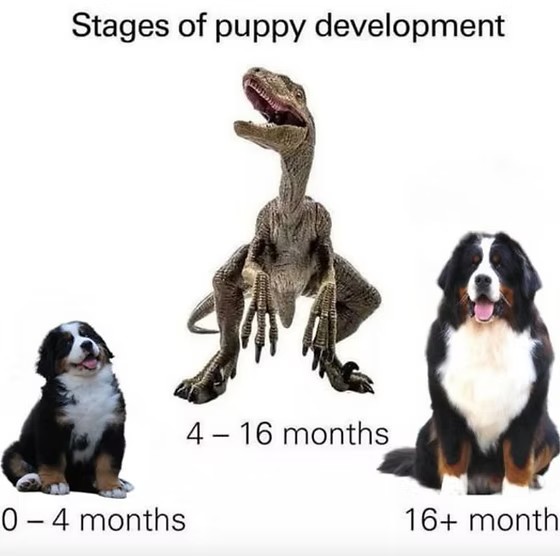
As funny as this photo may seem, it actually holds a lot of truth!
(Also, as a small parenthesis here, we’d like to point out that while it can happen that Berners start curbing teenager behaviors around 16 months old, in our experience, that is more commonly seen with females. Males have a tendency to mature incredibly slowly, and can (and often do) behave like teenagers well over 2 years of age.)
Now back to our regular programming.
Out of both scenarios we previously mentioned, you have likely met one of the two sides, but rarely will you meet a teenager. The teenager Berner is likely being chased by their family for doing something unexpected at the perfect moment, which was, when nobody was looking.
Bernese are a large breed, and they develop incredibly slow, this is both physically and mentally. A lot of families make the incorrect assumption that because their dog is looking physically big at 1 year old, that means their dog is fully grown. This is a big mistake.
Bernese do not stop developing until they are closer to 2.5 to 3 years of age, regardless of what their physique is telling you. There is still a lot of maturing going on with bones, growth plates and mental acumen.
For the purpose of this entry, we will focus on behavior however.
When a puppy goes home, it is usually all very cute. Puppies fall in love with their families, as much as their families tend to fall in love with them at that age. From day 0 to around 4-6 months of age, puppies are ALL about their families, they will follow them, do anything they ask, sleep next to them, be enamored and content to please as much as possible (not discounting the puppy shenanigans discussed in “The Naughtiness behind a Berner pup” entry.)
But around 5-8 months of age, there is a phenomenon that tends to take a lot of families by surprise. The Velociraptor stage, also known as, “The Teenager Stage” is one we should all be bracing for.
This stage is usually identifiable by the increased level of frustration that follows:
- Boundaries constantly being challenged.
- Socks, shoes and / or clothing disappears.
- Furniture getting chewed.
- Recalls become non-existent.
- What used to be a cute fluffy seal jumping up at you, it is now a 50-80 lb dog capable of tackling you down with a jump.
- Every command previously mastered seems to have been forgotten.
- Parents are boring unless they have food (and we mean GOOD food. No cheating with the cheap biscuits!)
- Saying “No” is a new way of saying “Yes, good dog, do more of that”.
- Plummeting to the ground and deciding not to keep walking while on a leash.
- For families with male Bernese, this is also the time in which they may start observing mounting or humping behavior (altho in general, if the individual dog showcases it, this usually starts around 10-16 months of age)
Listen, it is not easy, we’ve been there, and we are here to tell you, you can do this!
If you did the work while your puppy was in the “moldable” stage between 2 and 4-5 months, then you have set yourself up for a much better time, even though it will still be frustrating. If you have not done any training with your puppy, then things can get really dicey.
In a general sense, young teenagers see typical human behavior as something incredibly alluring. “I took their shoe and now they are chasing me?! This is the best game ever!”
If you observe young teenager dogs play in the same space together, you’ll observe a lot of similar behaviors they apply in their human household. Games of “tag”, “hide and seek”, “Catch me if you can”, they steal each other’s sticks or toys, and experience a real sense of joy when being chased, pursued or getting away with “it”, whatever the “it” may be.
For most humans that is not the definition of fun, it is usually the definition of frustration. But, as always, we would like to remind you, this is a stage / phase, and it will pass. Also, it is not a personal attack towards you, it is the discovery of individuality and sense of self. Yes, dogs go through those as well.
AH, The memory lane...
We fondly (yet-frustratingly) remember, when Kardia turned 6 months old. She went from being the perfect cuddly, studious, and A+ obedience student, into a velociraptor determined to wrack havoc in her wake. Destroying the garden became her ultimate obsession. She dug up the irrigation system, and chewed up pretty much any and all plants available to her teeth. At that time, she was receiving constant obedience lessons, she met lots of people on a daily basis, as well as new animals, she was also getting lessons on how to ride next to a bicycle, and spent most of her time with her human. You’d think that would be enough to curb the velociraptor within her, but it was not to be the case!
If we could convey to you the levels of frustration experienced during that time we would, but there are no words in the English dictionary that would suffice. Needless to say, we stuck with it, and we made it through the teenager tunnel.
You may not outrun the frustration, but you can turn it into prevention. Prevention is your friend!
With Kardia, we limited her time in the yard, we began a more intense training and reinforcing program that allowed her to thrive by understanding her boundaries. This took months of ongoing training, and it had its peaks and valleys.
For most families, this stage should involve a lot of proactive training or in other words: prevention training.
It helps to focus on what your individual Bernese likes to be naughty with. For Kardia, it was the garden. For others it’s socks, or shoes, or counter surfing.
Put the socks, and shoes away, and if possible block access to the counter / kitchen.
The less you have to correct, the less you’ll be frustrated since you’ll be closing “Windows of opportunity”, hence we say prevention is your friend!
It takes repetition. It is about the follow-through. If you manage to put socks away 9 out of 10 times, and it only stole the sock once, that is a great start. They will get away with it a few times, but discipline, repetition and follow-through is what wins at the end of this marathon.
Dog training, in whichever behavioral stage they may be in, is a marathon, not a race.
Properly bred and raised Bernese are an incredibly social breed. In general, they tend to love other dogs, and people. Responsible, and well organized Doggy-Day Cares are often a wonderful addition to any training program. They usually meet dogs of all ages, and they learn things with other dogs that we as humans struggle to teach nearly as fast as they teach each other.
Young teenagers have a lot of energy, but Berners as a slow growing breed should not get a lot of high impact, or demanding exercise, as that is detrimental to their joints, bones and overall development. This is why Doggy-day cares and other equally mentally engaging activities are key to their behavioral development. Swimming lessons are another thing you and your berner could do together. It is a mentally engaging, low-impact activity, and can provide a wonderful bonding time.
There are lots of ways to get through this (often) challenging stage.
When young teenager Berners are not properly enriched they usually present hyperarousal behaviors generally displayed by: playing too rough, being destructive, mounting, or barking.
This is not to say that those behaviors cannot present themselves without it. It all depends on the context of the situation, but they are commonly seen in such instances.
We always recommend our families to work closely with a positive reinforcement trainer with their Berner. This is particularly important for first time Berner families. This breed can be a wonderful addition to the right family, but as we mentioned earlier in this blog, this breed is not born the perfectly well behaved floof you usually encounter out in the world. It takes time, dedication, perseverance, knowledge, lots of treats, age-appropriate mental and physical stimulation, and lots and lots of repetition. Dogs thrive on routine after all.
A word on mounting behaviors
Male teenagers have a tendency to mount or hump usually due to overarousal. It all depends on the context of the situation and the individual Berner, however, this is something families should be aware of before deciding to bring a boy into your home.
As a slow mature breed, and with science behind this statement, Bernese should not be neutered / fixed before 2.5 to 3 years of age. This is detrimental to their joints and health. Testosterone is a normal and healthy hormone that can incite certain behaviors. However, most mounting behaviors are usually due to hyperarousal, not “mounting to breed” per se.
Fixing a male dog as a way to “fix” this behavior is usually an extreme way of getting rid of a natural behavior. It may be frustrating to some families, but this behavior is very similar in nature to that of mouthing / teething.
It will get worse, before it gets better.
Once again, we strongly recommend working with a positive reinforcement trainer to help you learn tools to redirect, curb, or focus this behavior. Much like we do not remove their teeth simply because we don’t want them to mouth us, we recommend trying to avoid thinking about neutering as a solution, just so they don’t mount us or things.
On one hand mounting can be frustrating, but it passes. On the other hand, castration removes hormones needed for proper development that may hinder our Bernese for the rest of its life, including higher possibility of joint disorder and certain cancers. As such, for us as breeders seeking what is best for their development and life-long well being, we advocate against neutering as a “behavioral” solution.
Finally, we’d like to say that Mounting does not just apply to males. Certain females will partake in this behavior from the same source as males, which more often than not tends to be hyperarousal.
It will be okay!
The Velociraptor or Teenage phase is one with many caveats, for most of us, it teaches patience, consistency, and new ways to do things.
Our dogs are constantly teaching us new things.
If you feel a behavior is out of your depth, be kind to yourself, and seek help from a professional trainer. Dogs hardly do behaviors with the intention to frustrate us, it usually is an interspecies miscommunication and growing pains which are generally normal for their age.
While we understand it can be frustrating, and at times you may be wondering why you brought such a naughty Berner into your life. Let us remind you that it is part of the journey. You are not alone, they all get into all sorts of shenanigans in their teenage phase.
Deep breaths! You’ll get through it together. Before you know it, it’ll be a floof begging for all the belly rubs, and you’ll be wondering what happened to that velociraptor you were just beginning to understand.
Keep reading
This post is part of our puppy series. Read it in order:
- Raising Large Breed Puppies: An Introduction
- New Owner Transition: The Beginning
- The Wet Sock Vortex
- Crate & Potty: The greatest BFF’s
- The Chewed Sock Vortex
- The Naughtiness behind a Berner Pup
- Teenagers: The Unexpected Switch (you are here)